
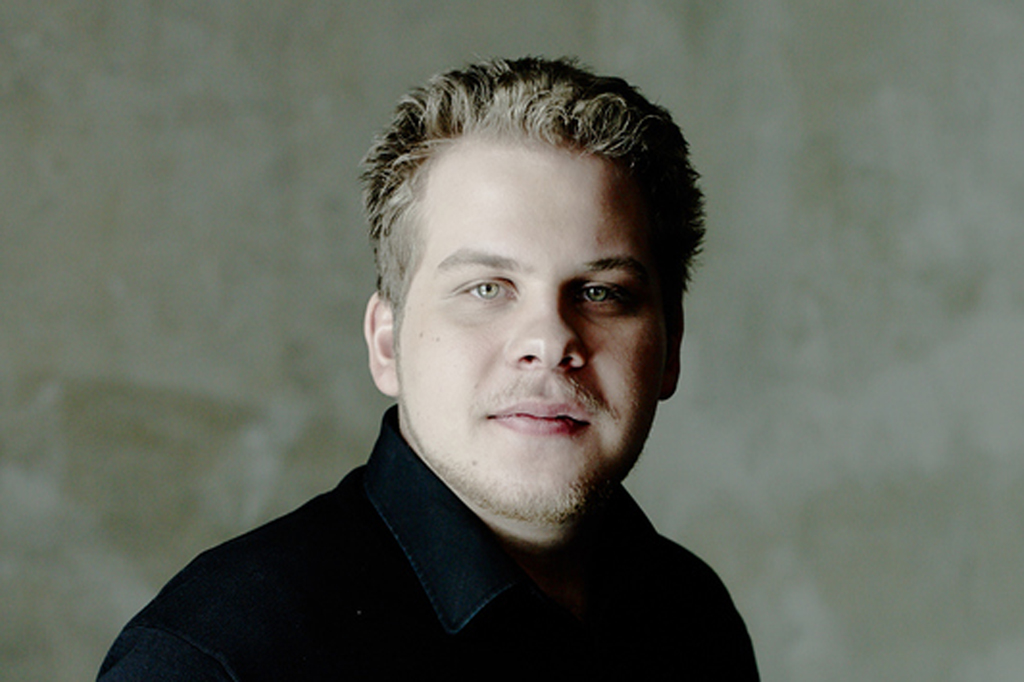
With a „dark, velvety“ voice that is „moving, but also shows depth and character“ and a „stage presence that is second to none“ (Das Opernglas), the young Austrian bass-baritone Michael Nagl is establishing himself on the world’s most important stages.
Highlights of the 2025/26 season include a new production of “The Cunning Little Vixen”/’Haraschta’, a new production of “Le nozze di Figaro”/‘Figaro’ at the Amsterdam Opera, “Die Winterreise” accompanied by pianist Vlad Iftinka in Stuttgart, concerts and a CD production of “Die Schöpfung” at the Konzerthaus Berlin under the baton of Joana Mallwitz, and Beethoven’s “Symphony No. 9” with the Stuttgart Philharmonic Orchestra. The artist will also return to the Dresden Opera and the Vienna State Opera, among others.
In the summer of 2025, the artist made his debut as ‘Figaro’ in the new production of “Le nozze di Figaro”, followed by an equally successful series of “The Magic Flute” at the Vienna State Opera. Highlights of previous seasons included his debut at the Salzburg Festival as ‘Papageno’ in “Die Zauberflöte”, followed by his house debut at the Theater an der Wien as ‘Gobrias’ in “Belshazzar”, among other roles. Michael Nagl is a member of the ensemble at the Stuttgart State Opera, where he has performed as ‘Leporello’ in “Don Giovanni”, ‘Figaro’ in “Le nozze di Figaro”, ‘Basilio’ in “Il barbiere di Siviglia”, the bass part in a staged performance of “St. John Passion”, and most recently as the ‘Ghost Messenger’ in a new production of “Die Frau ohne Schatten” in Stuttgart. Selected song recitals, e.g., with Thomas Guggeis, are also part of his work in Stuttgart. Guest engagements take the artist to the Semperoper Dresden as ‘Figaro’ and ‘Papageno’ and to the Konzerthaus in Berlin in concert performances of “The Seven Deadly Sins” conducted by Joana Mallwitz.
Born in Vienna in 1995, the singer has enjoyed success in recent years with his debuts at the Opéra National in Paris as the ‘First Priest’ and ‘Second Armorer’ in “The Magic Flute,” at the Bregenz Festival as ‘Donner’ in “Das Rheingold,” at the Opéra du Rhin in Strasbourg as ‘Leporello’, and at the Opéra national de Lorraine in Nancy as ‘Papageno’. He made his debut as ‘Conte di Cepreano’ in “Rigoletto” at the Semperoper in Dresden and with the Berlin Radio Symphony Orchestra in Stravinsky’s “Pulcinella” at the Berlin Philharmonic. With the Gürzenich Orchestra Cologne, he performed as ‘Polydor’ and ‘Père de famille’ in Berlioz’s “L’enfance du Christ” in Cologne Cathedral, and Michael Nagl made his debut at the Vienna Musikverein in Bach’s” Christmas Oratorio”. His debut at La Scala in Milan as the ‘Fifth Jew’ in “Salome” under Riccardo Chailly in a new production by Damiano Michieletto had to be cancelled due to the coronavirus pandemic.
Michael Nagl received his basic musical and vocal training with the Wiener Mozartknaben (conductor: Peter Lang). The bass-baritone has performed on many important stages across Europe during numerous concert tours, gaining valuable stage experience. In the summer of 2016, the young artist completed his vocal studies at the University of Music and Performing Arts Vienna in the class of Prof. Karlheinz Hanser. The bass-baritone celebrated his successful stage debut in March 2014 at the Schönbrunn Palace Theater as ‘Don Alfonso’ in “Così fan tutte”. He made his professional debut at the Stadttheater Baden as ‘2nd Armored Man’ and ‘Leporello’.
During his studies, Michael Nagl performed at the Schönbrunn Palace Theater as ‘Masetto’, ‘Leporello’, and ‘Simone’ in “Gianni Schicchi”. In the summer of 2014, he won the prize for best young singer at the ‘Otto Edelmann Singing Competition’. In 2015, he was awarded the Gottlob Frick Medal at the ‘Gottlob Frick Society’s artists‘ meeting’.
The young singer has already worked with conductors such as Sylvain Cambreling, Thomas Guggeis, Marie Jacquot, Lothar Koenigs, Oksana Lyniv, Cornelius Meister, Andrés Orozco-Estrada, Francois-Xavier Roth, Marc Soustrot, Andreas Spering, Lorenzo Viotti, and Bas Wiegers, as well as with directors such as Lotte de Beer, Frank Castorf, Peter Konwitschny, Marie-Eve Signeyrole, and Jossi Wieler.